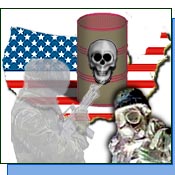
The first use of chemical and biological
weapons has been traced back to the sixth century, before the common era,
when the Assyrians poisoned their enemy's well with rye ergot. Smallpox
was even used as a biological weapon when the English gave the Indians,
who were helping the French, smallpox infested blankets during the French
and Indian War of 1754. Japan started a biological warfare program
in a lab called Unit 731, in 1937. Investigation found that experiments
of aerosolized anthrax was found on approximately one thousand human corpses.
The Japanese were also discovered of having planes drop plague infected
fleas in China.
The United States began research into
using biological and chemical weapons as an offensive threat in 1943.
This was started because of a perceived German biological warfare threat.
In 1969, president Nixon stopped all offensive biological and toxin weapon
production and research. In 1953, the United States also had a medical
defensive program , which still runs today.
The United States and other counties signed on the Prohibition of the Development,
Production, and Stockpiling of Biological and Toxin Weapons, usually called
the Biological Weapons Convention. The treaty prohibits the stockpiling
of biological agents for military purposes and also prevents research into
offensive use of biological agents. Iraq and Soviet Union signed
on this treaty however, despite the treaty, research continued in countries
hostile towards the United States.
In 1991, the first United Nations
inspection of Iraq, after the Gulf War, found biological warfare capabilities.
Representatives of the Iraqi government admitted they had done research
into the offensive use of anthrax, botulinum toxins, and other biological
toxins. Further information was found, in 1995, that Iraq was conducting
research on several biological weapons. Traces of toxins were found
in fields and biological agents were found in rockets, bombs, and spray
tanks.
The threat of chemical and biological
warfare has increased dramatically over the past two decades, with the
number of counties researching the offensive use of these deadly weapons.
Russian president Boris Yeltsin said he would put an end to biological
research, but their is no evidence of this. There is great concern
towards countries hostile to western democracies that there is a possibility
of research and production of biological and chemical weapons.
The threat of chemical and biological
weapons being used against the United States is greater than ever right
now. Therefore, knowledge and education of this potential hazard
is more crucial than ever.
References: NBC