Thirty years ago, the threat of infectious diseases appeared to be receding.
Modern scientific advances, including antibiotic drugs, vaccines against
childhood diseases, and improved technology for sanitation, had facilitated
the control or prevention of many infectious diseases, especially modern
industrialized nations. The occurrence of childhood diseases such
as polio, whooping
cough, and diphtheria was declining
due to the use of vaccines. In addition, American physicians had
fast acting, effective antibiotics to combat often fatal bacterial diseases
such as meningitis and pneumonia.
Deaths from infection were no longer a frequent occurrence in the United
States. Meanwhile, in other parts of the world, chemical pesticides
like DDT were lowering the incidence of malaria,
a major killer of children, by controlling populations of parasite carrying
mosquitoes.
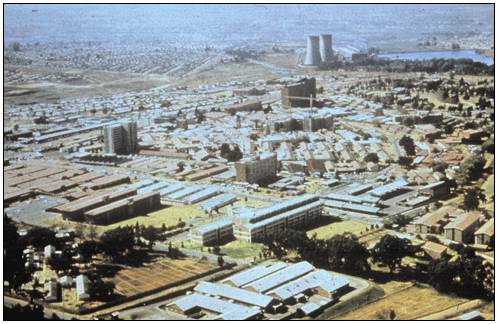
An aerial view of Chris Hani Baragwanath Hospital,
with 3,000 inpatients the
largest hospital in the world - Soweto, South Africa. Multiple-drug
reistant
pneumococci were found here in 1978.
But much to our dismay the methods of controlling these diseases are not enough. There are still infectious microbes, which have remarkable ability to evolve, adapt, and develop resistance to drugs in an unpredictable and spontaneous fashion. Also the increase spread of human populations into tropical forests and overcrowded mega-cities where people are exposed to a variety of emerging infectious agents.
Today, most health professionals agree that new microbial threats are appearing in significant numbers while well known illnesses thought to be under control are re-emerging. Most Americans are aware of the epidemic of the acquired immunodeficiency syndrome (AIDS) and the related increase in tuberculosis (TB) cases in the United States. In fact, there has been a general resurgence of infectious diseases throughout the world, including significant outbreaks of cholera, malaria, yellow fever, and diphtheria. In addition, bacterial resistance to antibiotic drugs is an increasingly serious worldwide problem. Furthermore, the number of people infected with the human immunodeficiency virus (HIV) that causes AIDS is increasing in many countries and may reach 40 million by the year 2000. Most recently, Ebola virus, which causes an often fatal hemorrhage illness, has appeared again in Africa, and a formerly unknown virus of the measles family that killed several horses in Australia also infected two men, one of whom died.
New diseases
have also appeared within the United States, including
Lymedisease, Legionnaires' disease,
and most recently hantavirus pulmonary syndrome
(HPS). HPS was first recognized in the southwestern United States
in 1993 and has since been detected in more than 20 states and in several
other countries in the Americas. Other new or re-emerging threats
in the United States include multidrug-resistant TB;
antibiotic resistant bacteria causing ear
infections; pneumonia; meningitis;
rabies;
and diarrheal diseases caused by the
parasite Cryptosproidium parvum and by certain toxigenic strains
of Escherichia coli bacteria.